Learning objectives
By the end of this lesson you will be able to:
- calculate current from nominal capacity and C-rate;
- calculate C-rate from a measured or datasheet current;
- calculate the ideal duration associated with a C-rate;
- use charge as the area under a current–time curve to explain why the ideal duration is 1 / C-rate;
- separate exact C-rate arithmetic from real-cell voltage-cutoff behavior;
- calculate nominal energy in watt-hours from capacity and voltage.
Before you start: Lesson 1 · Cell anatomy. Arithmetic with units is all the maths you need.
01Nominal capacity is charge, not energy
Nominal capacity, written , is usually reported in ampere-hours (Ah). It describes electric charge delivered under stated test conditions. It is not an energy rating, and on its own it says nothing about the cell’s voltage.
So a 20 Ah rating means that 20 amperes sustained for one hour would transfer 20 Ah of charge — in the ideal arithmetic sense. Whether a particular cell actually delivers that charge before reaching its voltage limit is a separate question, answered in section 05.
02C-rate is a normalized current
C-rate divides the current by the nominal capacity, so the same number means the same relative load on a 3 Ah phone cell and a 300 Ah stationary cell:
The units show why C-rate is tied to time. Amperes divided by ampere-hours leaves reciprocal hours:
Rearranging gives the two ideal relationships used everywhere in battery engineering:
The second expression contains no capacity, because the current has already been normalized by it. It is an ideal charge-transfer duration, not a prediction of when a real cell reaches its cutoff voltage.
| Label | C-rate | Current | Ideal duration |
|---|---|---|---|
| C/10 | 0.1 h⁻¹ | 2 A | 10 h |
| C/5 | 0.2 h⁻¹ | 4 A | 5 h |
| C/2 | 0.5 h⁻¹ | 10 A | 2 h |
| 1C | 1 h⁻¹ | 20 A | 1 h |
| 2C | 2 h⁻¹ | 40 A | 30 min |
| 5C | 5 h⁻¹ | 100 A | 12 min |
| 10C | 10 h⁻¹ | 200 A | 6 min |
03Three patterns in the rate table
1C is the reference point. For the 20 Ah example, 1C is 20 A and an ideal duration of one hour.
Doubling the C-rate doubles the current and halves the ideal duration. Moving from 1C to 2C changes 20 A to 40 A, and one hour to thirty minutes.
At the same C-rate, the ideal duration is the same for every capacity. A 3 Ah cell and a 300 Ah cell both have an ideal duration of 30 minutes at 2C — but they need 6 A and 600 A respectively.
That normalization is the whole point of C-rate. A current on its own does not tell you how demanding a load is until you know the capacity of the cell carrying it.
04Why duration is reciprocal: charge is area
Electric charge is the time integral of current. For a constant current it reduces to a product:
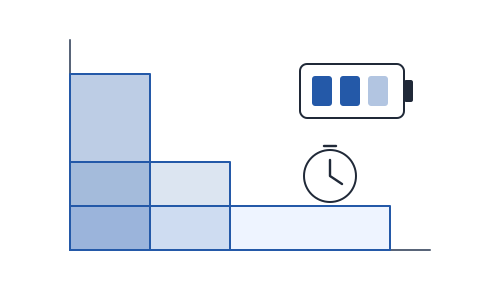
On a current-versus-time graph, transferred charge is therefore the area under the curve. Each rectangle below holds exactly 20 Ah:
05Ideal duration is not a runtime prediction
The equal-area picture assumes the full nominal capacity is available at the chosen current. A real cell is normally stopped when its terminal voltage reaches a specified limit, and the charge it can deliver before that limit depends on the cell and on the test.
| Effect | Why the measured duration can change |
|---|---|
| Ohmic voltage drop | A larger current produces a larger instantaneous terminal-voltage drop, so the lower cutoff can be reached sooner. |
| Polarization and transport | Concentration gradients and reaction overpotentials generally grow with current, changing how much charge is accessible before cutoff. |
| Temperature | Temperature changes resistance, kinetics, transport and usable capacity. |
| Chemistry and design | Electrode thickness, particle size, electrolyte and other design choices set the rate capability. |
| State of health | Aging changes both capacity and resistance — see Lesson 4. |
| Rating and test definition | Nominal capacity is tied to a specified current, temperature, rest conditions and voltage limits. |
At high current a cell often reaches its lower voltage limit before delivering its nominal charge. But the ideal duration is not a universal upper or lower bound either: usable capacity can be below, near or occasionally above the nameplate value, depending on the rating procedure and conditions.
This lesson does not show a rate-versus-capacity curve. Predicting cutoff time needs measured discharge data or a validated voltage model with cell-specific parameters — which is where Chapter 2 begins.
06From charge to energy: watt-hours
Capacity counts charge. How much work that charge can do also depends on the voltage it is delivered at, just as the same flow of water does more work falling from a greater height. Multiplying the two gives energy, in watt-hours (Wh):
The 20 Ah example cell, with a nominal voltage of 3.65 V, is rated at 20 × 3.65 = 73 Wh. The nominal voltage is a representative average over a full discharge — the voltage itself slides from about 4.2 V down to about 3 V for a typical oxide cell — so the result is a rating, not the energy of any one discharge.
| Cell or pack | Capacity | Nominal voltage | Nominal energy |
|---|---|---|---|
| Phone cell, “5,000 mAh” | 5 Ah | 3.85 V | 19.25 Wh |
| Oxide cell (NMC) | 3 Ah | 3.6 V | 10.8 Wh |
| Phosphate cell (LFP), same capacity | 3 Ah | 3.2 V | 9.6 Wh |
| The 20 Ah example cell | 20 Ah | 3.65 V | 73 Wh |
| A pack of 96 cells, 50 Ah and 3.65 V each, in series | 50 Ah | 350.4 V | 17.5 kWh |
Two lessons hide in that table. First, equal ampere-hours do not mean equal energy: the LFP cell stores about 11 % less energy than the oxide cell with the same capacity, because its voltage is lower. Second, in a pack, cells in series add their voltages and cells in parallel add their capacities, but either way the pack’s energy is simply the sum of its cells’ energies. Divide a cell’s energy by its mass and you get its specific energy, in Wh/kg; divide by its volume and you get its energy density, in Wh/L — the two figures most often used to compare cells.
That is also why airlines ask about batteries in watt-hours, not milliampere-hours: a spare battery of up to 100 Wh can generally travel in hand luggage, and larger ones need the airline’s approval or are not allowed. And it is why the energy a cell actually delivers falls faster than its charge at high current — the voltage sags under load, so each ampere-hour carries fewer watt-hours.
07Worked example: reading a datasheet
A datasheet lists a 3.2 Ah cell with a maximum continuous discharge current of 15 A. What C-rate is that, and what is its ideal duration?
That 12.8 minutes is a reference calculation, not a promise that the cell stays above its lower voltage limit for 12.8 minutes at 15 A. The real duration comes from the datasheet discharge curve, measured data, or a validated model at the stated temperature, voltage limits and cell condition.
08Calculate it in Python
Every number on this page comes from the same four tested functions in the open-source battery_core package:
from battery_core import (
    c_rate_from_current,
    current_from_c_rate,
    ideal_duration_hours,
    nominal_energy_wh,
)

current_from_c_rate(nominal_capacity_ah=20.0, c_rate=10.0)       # 200.0 A
ideal_duration_hours(10.0) * 60.0                                # 6.0 min
c_rate_from_current(current_a=15.0, nominal_capacity_ah=3.2)     # 4.6875
nominal_energy_wh(nominal_capacity_ah=20.0, nominal_voltage_v=3.65)  # 73.0 Wh
The conversion functions accept keyword arguments only. Capacity is the first parameter of one and the second of another, so a transposed positional call would return a plausible but wrong number with no error. Requiring names makes that mistake impossible.
Want to change the code and plot it yourself? Run the Lesson 2 notebook in your browser (no installation; the first launch can take a few minutes).
09Assumptions and limits
- Current is a positive magnitude; charge and discharge sign conventions belong to a later module.
- Nominal capacity must be strictly positive. Current and C-rate may be zero — a rest step is physical, and its C-rate is exactly 0.
- The ideal duration still needs a strictly positive C-rate, because is undefined.
- Energy is the nominal rating, capacity times nominal voltage. No voltage curve, delivered energy, heat, aging, kinetics or rate-dependent capacity is calculated.
10Check yourself
Work each one out before opening the answer.
A 50 Ah cell is discharged at 25 A. What is its C-rate and ideal duration?
25 / 50 = 0.5C, so the ideal duration is 1 / 0.5 = 2 hours.
Which has the shorter ideal duration at 2C: a 5 Ah cell or a 100 Ah cell?
Neither. Both have an ideal duration of 30 minutes. Their currents differ: 10 A for the 5 Ah cell and 200 A for the 100 Ah cell.
A 20 Ah cell is discharged at 40 A for 25 minutes before reaching its cutoff voltage. How much charge was delivered, and how does that compare with the nominal capacity?
40 × (25 / 60) = 16.7 Ah, about 3.3 Ah below the nominal rating under those test conditions. On its own this does not tell you how much charge would be usable at a different current, temperature or cutoff voltage.
A power bank is labelled 20,000 mAh, and its cells have a nominal voltage of 3.7 V. Is it under the 100 Wh limit for hand luggage?
20,000 mAh is 20 Ah, so its nominal energy is 20 × 3.7 = 74 Wh — under 100 Wh. The milliampere-hour figure alone could not answer the question, because a pack of the same capacity at a higher voltage would hold more energy.
Why is “10C always lasts exactly 6 minutes” not a valid real-cell prediction?
Six minutes follows from the ideal reciprocal relationship. Real cutoff time also depends on voltage limits, resistance, polarization, temperature, chemistry, design, state of health and the capacity-rating procedure.
11Practice quiz
Questions on this lesson. The numeric drills are marked in your browser and generate fresh numbers every time, so you can repeat them until the method is automatic; the written question you check against a model answer.
12References and further reading
These sources give broader battery-modeling context. The explanation, examples, code and tests in Battery Core are written independently.
- T. B. Reddy (ed.), Linden’s Handbook of Batteries, 4th ed., McGraw-Hill, 2011.
- G. L. Plett, Battery Management Systems, Volume I: Battery Modeling, Artech House, 2015.