Feasibility study from published sources. The makers do not publish what their batteries cost them, so the battery prices here are 2025 survey averages for commercial-vehicle packs. Every figure on this page is marked as published, derived or assumed, and an OEM can replace any of them with its own in the calculator, which runs the same code that produced the tables.
Abstract
We compared the battery of each maker's newest 4x2 electric tractor (Volvo, DAF, MAN, Scania and Mercedes-Benz) with one Lemonergy dual-battery system designed from real cells in the Lemonergy Pack Designer: a 425.9 kWh swappable LFP main pack in two side modules and a 147.2 kWh fixed LFP reserve. The system fits beside the frame, between the axles, on all five trucks. At published 2025 pack prices, selling the truck without the main pack, which a swap operator owns, lowers its battery cost by €45,600 (DAF XF Electric) to €87,600 (MAN eTGX) where the system carries at least the maker's energy, and by €101,100 on the Scania R BEV, which then carries 92 % of its energy. The cost of the swap interface comes off these figures; it is not published. On the three NMC and NCA trucks, €37,800 to €43,700 of the reduction comes from LFP alone, which a maker can also take without a swap system. If the fleet buys both packs, the dual system saves nothing by itself: it costs the interface. At 400 km a day, a swap operator can charge between €420 and €870 a month for the main pack and both sides gain: the operator's pack is paid for and the fleet pays less than owning it. Stations, spare packs and margin must fit inside that gap.
The question
An electric tractor carries 525 to 623 kWh of battery, and the battery is a large part of what the truck costs. In a dual-battery truck the battery is split in two: a large main pack that a swap station exchanges in minutes, and a smaller reserve that stays on the truck so it can always reach a station. If a swap operator owns the main packs, the truck no longer has to be sold with one. This study asks how much that takes out of the price of each truck, what it costs to make it work, and whether the packs fit where the makers put theirs today.
CATL offers the same split in China: a 77 kWh fixed pack and a leased 432 or 513 kWh main pack. CATL and Octopus Energy plan the first truck swap stations in the UK for 2027. No European swap price has been published yet.
The five trucks
Each maker's newest 4x2 tractor with its largest battery, so the comparison is like for like. Four of the five drive the rear axle through a propshaft from a central motor; the Mercedes-Benz eActros 600 has an electric axle, which leaves the space under the frame between the axles free.
| Truck | Installed (kWh) | Usable (kWh) | Chemistry | Battery mass (kg) | Drive |
|---|---|---|---|---|---|
| Volvo FH Electric FH / FH Aero Electric, 4x2 tractor (2026 line-up) | 540 published | 460 published | NCA published | 3,000 published | central motor, 8-speed gearbox, propshaft published |
| DAF XF Electric XF 310 FT, 4x2 tractor (new generation) | 525 published | — not published | LFP published | — not published | central motor (PACCAR EX-D2), propshaft published |
| MAN eTGX eTGX, 4x2 tractor (new generation, IAA 2026) | 552 published | 528 derived | NMC published | — not published | central drive (eCD), propshaft published |
| Scania R BEV R BEV, 4x2 tractor with the under-cab module (2026) | 623 derived | 560 published | NMC published | — not published | central motor with 4- or 6-speed gearbox, propshaft published |
| Mercedes-Benz eActros 600 eActros 600 LS 4x2 tractor | 621 published | 600 published | LFP published | 4,450 published | e-axle, 4-speed, no propshaft published |
Chassis values used for the fit
| Truck | Wheelbase | Front axle to back of cab | Frame top | Frame height | Fifth wheel ahead of rear axle | Cab width | Frame width |
|---|---|---|---|---|---|---|---|
| Volvo FH Electric | 3,950 published | 1,007 published | 982 published | 266 published | 825 published | 2,500 published | 850 assumed |
| DAF XF Electric | 3,900 published | 830 published | 980 published | 260 published | 770 published | 2,500 published | 850 assumed |
| MAN eTGX | 3,750 published | 900 assumed | 1,000 assumed | 270 assumed | 600 assumed | 2,500 assumed | 850 assumed |
| Scania R BEV | 4,150 published | 900 assumed | 1,000 assumed | 270 assumed | 600 assumed | 2,500 assumed | 850 assumed |
| Mercedes-Benz eActros 600 | 4,000 published | 850 assumed | 1,000 assumed | 270 assumed | 650 published | 2,500 published | 850 assumed |
The DAF and the Mercedes-Benz already use LFP, the chemistry of the Lemonergy packs; Volvo uses NCA and MAN and Scania NMC. Scania publishes only the usable energy of its 2026 battery; the installed energy is calculated from MAN's 89 kWh pack, which Scania now uses.
The Lemonergy system
One system for all five trucks, designed in the Lemonergy Pack Designer from real cells. The swappable main pack is two identical side modules, one on each side of the frame, so a swap network stocks a single module type whichever truck arrives. Each module is one full-voltage string, so the truck can run on either. The fixed reserve is two strings of a 105 Ah LFP cell, one module on each side: in our simulated 800 km route (the dual-battery truck study) this two-string reserve is the one with which the truck completes the route.
| Module | Cell, string | kWh each | Volts | Length × width × height (mm) | kg each | Spread across the module |
|---|---|---|---|---|---|---|
| Swappable main, one per side | CATL 302Ah LiFePO4, 219s1p | 213 | 548–799 | 1,384 × 702 × 645 | 1,289 | 3.4 K |
| Fixed reserve, one per side | EVE LF105, 219s1p | 73.6 | 548–799 | 528 × 719 × 625 | 479 | 4.2 K |
| Third reserve string, under the frame (e-axle truck) | EVE LF105, 219s1p | 73.6 | 548–799 | 1,579 × 719 × 230 | 489 | 1.6 K |
| Standard system | 2 main + 2 reserve | 573.1 | 3,535 |
Module sizes and masses are the Pack Designer's: cells, busbars, spacers, side cold plates and 2 mm walls. No housing, crash frame, mounting or swap interface is designed here; what the side space leaves for them is shown below. With the Pack Designer's default bottom cold plate, three cell layers fail its thermal check (13 K across the module); side plates bring the modules within its 5 K allowance, which is why they are used.
Does it fit?
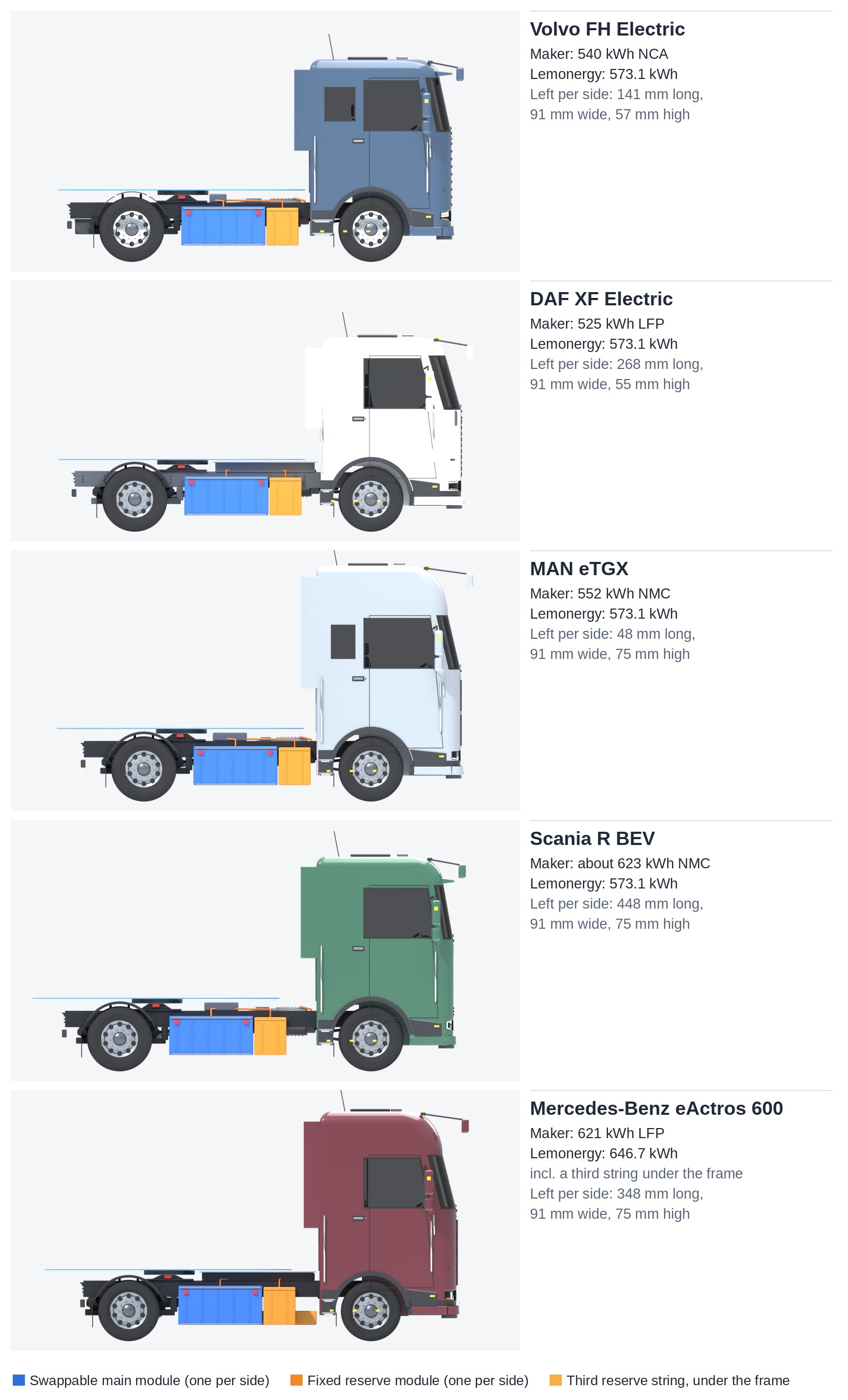
The packs go where the makers put theirs: beside the frame, between the axles. On each side the reserve module sits in front and the swappable main module behind it, and the main module slides out sideways at the station. Every module stays inside the truck's width, below the top of the frame, so nothing reaches into the space the trailer swings through, and at least 270 mm above the road.
| Truck | Side space, length × width × height (mm) | Length left (mm) | Width left (mm) | Height left (mm) | Energy carried | Battery mass, front / rear axle (kg) |
|---|---|---|---|---|---|---|
| Volvo FH Electric | 2,073 × 810 × 702 | 141 | 91 | 57 | 573.1 kWh, 106 % of the maker's | 1,590 / 1,945 |
| DAF XF Electric | 2,200 × 810 × 700 | 268 | 91 | 55 | 573.1 kWh, 109 % of the maker's | 1,610 / 1,925 |
| MAN eTGX | 1,980 × 810 × 720 | 48 | 91 | 75 | 573.1 kWh, 104 % of the maker's | 1,675 / 1,860 |
| Scania R BEV | 2,380 × 810 × 720 | 448 | 91 | 75 | 573.1 kWh, 92 % of the maker's | 1,513 / 2,022 |
| Mercedes-Benz eActros 600 | 2,280 × 810 × 720 | 348 | 91 | 75 | 646.7 kWh, 104 % of the maker's with the third reserve string under the frame | 1,570 / 1,965 |
All five fit, with 48 to 448 mm of length, 91 mm of width and 55 to 75 mm of height left on each side. The standard system carries 573.1 kWh, at least the maker's energy on the Volvo, DAF and MAN. The Scania and Mercedes-Benz carry more. On the Mercedes-Benz the electric axle leaves the space under the frame free, and a third reserve string fits there as one flat layer (1,579 × 719 × 230 mm). On the Scania a propshaft runs there, so the system stays at 92 % of Scania's energy unless the third string goes where Scania puts its under-cab module, which is not published.
Battery mass: the standard system's modules weigh 3,535 kg without housing. The published masses are Volvo FH Electric 3,000 kg for 540 kWh, Mercedes-Benz eActros 600 4,450 kg for 621 kWh. The eActros 600's housed LFP system, 7.17 kg/kWh, puts a housed 573.1 kWh LFP system near 4,110 kg.
Purchase price
The battery cost each truck is sold with, at the published price of its chemistry, against the Lemonergy system with the swappable main pack owned by a swap operator. The truck is then sold with the fixed reserve and the swap interface only. The middle column is the effect of the chemistry alone: the same energy as one LFP pack, which a maker can take without any swap system.
| Truck | Battery today | Battery cost today | Reduction: same energy, one LFP pack | Reduction: Lemonergy, main pack rented (B) | Energy on the truck | Break-even interface cost (B) |
|---|---|---|---|---|---|---|
| Volvo FH Electric | 540 kWh NCA at €190.9/kWh | €103,100 €87,000 to €103,100 | €37,800 €0 to €51,500 | €85,300 less the interface €63,300 to €89,000 | 573.1 kWh (106 %) fixed 147.2 kWh bought | €85,300 |
| DAF XF Electric | 525 kWh LFP at €120.8/kWh | €63,400 €50,200 to €84,600 | €0 €0 to €0 | €45,600 less the interface €36,100 to €60,900 | 573.1 kWh (109 %) fixed 147.2 kWh bought | €45,600 |
| MAN eTGX | 552 kWh NMC at €190.9/kWh | €105,400 €88,900 to €105,400 | €38,700 €0 to €52,600 | €87,600 less the interface €65,200 to €91,300 | 573.1 kWh (104 %) fixed 147.2 kWh bought | €87,600 |
| Scania R BEV | 623 kWh NMC at €190.9/kWh | €118,900 €100,300 to €118,900 | €43,700 €0 to €59,400 | €101,100 less the interface €76,600 to €104,900 | 573.1 kWh (92 %) fixed 147.2 kWh bought | €101,100 |
| Mercedes-Benz eActros 600 | 621 kWh LFP at €120.8/kWh | €75,000 €59,400 to €100,000 | €0 €0 to €0 | €48,300 less the interface €38,300 to €64,500 | 646.7 kWh (104 %) fixed 220.8 kWh bought | €48,300 |
Prices: LFP €120.8/kWh (€95.6/kWh to €161.1/kWh), NMC and NCA €190.9/kWh (€161.1/kWh to €190.9/kWh), derived from BloombergNEF's 2025 pack prices and converted at the ECB's 2025 average of 1.13 USD per euro. The IEA likewise puts LFP packs more than 40 % below NMC per kWh in 2025. At the base prices, the swappable pack alone is worth €51,500. For context, BloombergNEF puts the average European battery-electric tractor at €310,000 and the diesel at €130,000 in 2026.
Battery cost is energy times the pack price; the truck's list price moves by that amount plus the maker's margin on it, which is an input in the calculator (0 % here). The interface (swap latches and connectors, the second pack's contactors and DC/DC converter) has no published cost, so each row gives the interface cost at which the saving would be zero.
If the fleet buys both packs
A dual system does not make a battery cheaper by itself. If the fleet buys the main pack as well, the truck carries LFP instead of the maker's chemistry, plus the interface. For a maker that already uses LFP the result is the interface cost and nothing else.
| Truck | Lemonergy packs | Reduction against today's battery | Of which from the chemistry at equal energy | Range |
|---|---|---|---|---|
| Volvo FH Electric | 573.1 kWh LFP, €69,200 | €33,900 | €37,800 | −€5,300 to €48,300 |
| DAF XF Electric | 573.1 kWh LFP, €69,200 | −€5,800 | €0 | −€7,700 to −€4,600 |
| MAN eTGX | 573.1 kWh LFP, €69,200 | €36,100 | €38,700 | −€3,400 to €50,600 |
| Scania R BEV | 573.1 kWh LFP, €69,200 | €49,700 | €43,700 | €8,000 to €64,100 |
| Mercedes-Benz eActros 600 | 646.7 kWh LFP, €78,100 | −€3,100 | €0 | −€4,100 to −€2,500 |
The two columns differ only by the energy: the Lemonergy packs carry more than the Volvo FH Electric, DAF XF Electric, MAN eTGX, Mercedes-Benz eActros 600 batteries and less than the Scania R BEV's. A negative figure means the packs cost more than the maker's battery.
What the swap may charge
With model B the fleet pays the swap operator instead of buying the main pack. Nothing in Europe tells us that price yet, so the study brackets it. The ceiling is what the main pack would cost the fleet if it bought it: its price as a level monthly payment at the euro-area borrowing rate over the fleet's ownership period, less what the pack is still worth at the end. The floor is what the same pack costs a swap operator for this truck's use: its price spread over its cycle life at the same rate. A swap service between the two is cheaper for the fleet and still pays the operator for the pack; stations, spare packs, logistics and margin have to fit in the gap.
| Bound | Per month | What it is |
|---|---|---|
| Ceiling, pack worth nothing at the end | €870 | Owning the pack over 5.5 years at 3.59 % |
| Ceiling, pack sold at its remaining life | €460 | The same, less the value of the 57 % of its cycle life left after 5.5 years |
| Floor, the operator's pack | €420 | The pack's price over its 12.9-year life on this truck's use, at the same rate |
Use: 400 km a day (the condition CATL states for its own claim), 300 days a year, 1.1 kWh/km (the mean of the ICCT's three long-haul use cases): 132,000 kWh a year through the main pack, whose 4,000 full cycles then last 12.9 years. Change the route in the calculator: the floor rises with the daily distance, the ceiling does not.
Enter your own prices
Every input below starts at the value used in this study. Replace any of them with your own (your battery price, your interface cost, your margin, your route) and every result recalculates in your browser with the same code that produced the tables above. Nothing you enter leaves this page.
| Truck | Battery cost today | Same energy, one LFP pack | Both packs bought (A) | Main pack rented (B) | Break-even interface (B) |
|---|
What this study does not show
- The makers' own battery prices. They are not published. The prices here are BloombergNEF's 2025 survey of commercial-vehicle packs outside China, weighted by chemistry; NCA has no separate published price and is priced as NMC.
- The interface cost. Not published; the study gives the cost at which each saving reaches zero.
- Housing, crash frame, mounting and the swap mechanism. The modules are cells, busbars, spacers, cold plates and walls. The margins in the fit table are what is left for these; whether that is enough is a design task for the maker.
- Parts the makers keep in the same space. Air tanks, low-voltage batteries and other parts sit where each maker chose. The model checks the packs against every part it draws; it cannot check parts it does not know.
- Chassis values that are not published. Volvo and DAF publish body-builder sheets and Mercedes-Benz an order sheet; for MAN and Scania most heights and the position of the cab are assumptions, marked in the truck table.
- Mass and payload. The LFP system is heavier than an NMC or NCA battery of the same energy. The study shows the masses; it does not price lost payload.
- Price movements since 2025. LFP storage cells in China rose by about 22 % from October 2025 to April 2026 (InfoLink), and Benchmark's third-quarter 2026 review shows cell prices still moving. The base stays at the 2025 survey, so all five trucks are priced from the same year; enter a current price in the calculator.
- Energy cost. Charging energy is taken as the same in every case and left out. Swap stations, their energy and their utilisation are not published in Europe; the Chinese figures in the sources are context, not inputs.
- Battery life and value at resale. The cycle life is the LFP cells' rating; no NMC or NCA truck pack life is published, so the study does not compare replacements.
Method
For each truck, with E the maker's installed energy, pm the pack price of its chemistry, pL the LFP pack price, Es and Ef the swappable and fixed energies of the Lemonergy system and I the interface cost:
- Battery cost today: E · pm.
- Same energy, one LFP pack: reduction E · (pm − pL).
- Both packs bought (model A): reduction E · pm − (Es + Ef) · pL − I.
- Main pack rented (model B): reduction E · pm − Ef · pL − I; break-even I is the reduction before the interface.
- Ranges: the maker's chemistry and LFP each take the low, base and high published price independently; where the maker uses LFP itself, both take the same price.
- Rent ceiling: (C − R/(1+i)n) · i/(1 − (1+i)−n), with C = Es · pL, n the ownership period, i the borrowing rate and R the pack's value at the end: zero, or its remaining cycle life at the price new. Rent floor: C · i/(1 − (1+i)−L), with L the years the pack lasts on this truck's daily energy.
- Fit: the side space runs from 50 mm behind the cab to 820 mm ahead of the rear axle, from 15 mm outside the frame rail to the cab's half-width, and from 270 mm above the road to 10 mm below the frame top. The 3D model built from the same values checks every pack against every part of the truck.
The code is in the Lemonergy Design repository (js/dual-battery-truck-feasibility.js for the prices and the fit, js/dual-battery-truck-feasibility-packs.js for the Pack Designer modules) and runs on this page unchanged.